Finders
Keepers
Turning the overwhelming, maze-like hunt for in-store sale items into a playful treasure hunt
where every discount feels discovered, not scavenged.
4x
faster to find a deal
92%
Task Completion in tests
12
User Interviews + observations
Scroll to hunt
01 • OVERVIEW
The 30 second pitch
Off-price retailers like Ross, Marshalls, TJ Maxx and Nordstrom Rack offer huge markdowns but the in-store experience is chaos. Layouts are inconsistent, signage is poor, and shoppers either give up or overbuy.
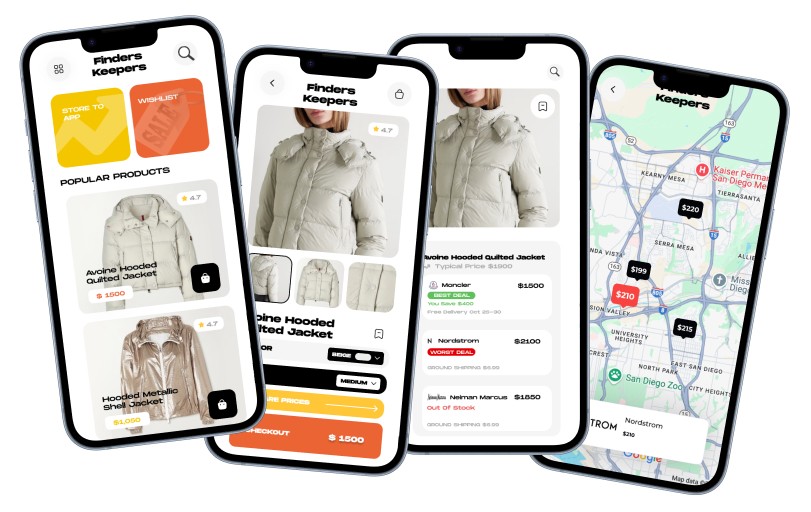
Finders Keepers is a mobile app that reframes bargain-hunting as a treasure hunt. It surfaces the best deals nearby in real time, shows a visual savings breakdown, and uses flash-sale mechanics to give shoppers a sense of play without the decision fatigue.
the outcome
A prototype that 5 of 6 users finished without hesitation, compared to 2 of 6 in the first round and that made 4 testers say they'd download it today.
ROLE
Sole product designer
TEAM
solo cSE 170 Capstone
timeline
8 weeks • winter 2025
tools
Figma • FigJam • Miro • Notion
scope
research → Hi-fi prototype → testing
platform
iOS Mobile first
02 • THE PROBLEM
How do you design for a thrill that's also a chore?
research question
"How do various factors influence shoppers to purchase sale items vs regular priced items"
Off price stores win on price but lose on experience. The same shoppers who love TJ Maxx will abandon a trip when they can't find their size, can't tell which rack is clearance, or feel rushed by a flash sale they don't trust.
03 • RESEARCH
Watching shopper hunt.
I ran a mixed-methods study over three weeks in-store observations at four off-price retailers, intercept interviews, and a survey of 42 discount shoppers.
when

Morning: Older shoppers

Mid-day: Younger & families

Weekends: All ranges

Peak: 2pm - 6pm
what
• Time spent per store visit
• Basket size & spend per trip
• Navigation patterns & zones visited
• Items touched vs. items purchased
how
• 4 store shadow sessions
• 4 intercept interviews
• 22 person survey
• 3 deep follow-ups
where
Marshalls • La Jolla Village
Nordstrom Rack• La Jolla Village
T.J. Maxx • Clairemont
I walk in knowing I want a coat and I still leave with, like, five candles I didn't need.
maya, 28 • tj maxx • regular
If it says 70% off I assume it's a lie until I see the original tag.
John, 43 • tj maxx • regular
The fun part is finding something no one else found. The annoying part is literally everything else.
Dani, 21 · Nordstrom Rack
It's like a treasure hunt but the treasure is a $9 spatula you didn't know you needed.
Kevin, 57 · ROSS OCCASIONAL
I don't make the list. The store decides what I need.
Priya, 32 · Marshalls weekly
04 • insights
four needs, one north star
01
Clarity
Clarity in navigation
Inconsistent store layouts and poor signage make the sale section feel hidden. Shoppers want a map, not a maze.
02
Value
Value perception
"70% off" is meaningless without proof. Shoppers trust transparent before/after prices and "lowest in 30 days" signals.
03
Focus
Decision fatigue
Too many options = paralysis. Shoppers need a personal, short list not another infinite feed.
04
Play
The treasure-hunt itch
Too many options = paralysis. Shoppers need a personal, short list not another infinite feed.
05 • WIREFRAMES & IA
Mapping the hunt.
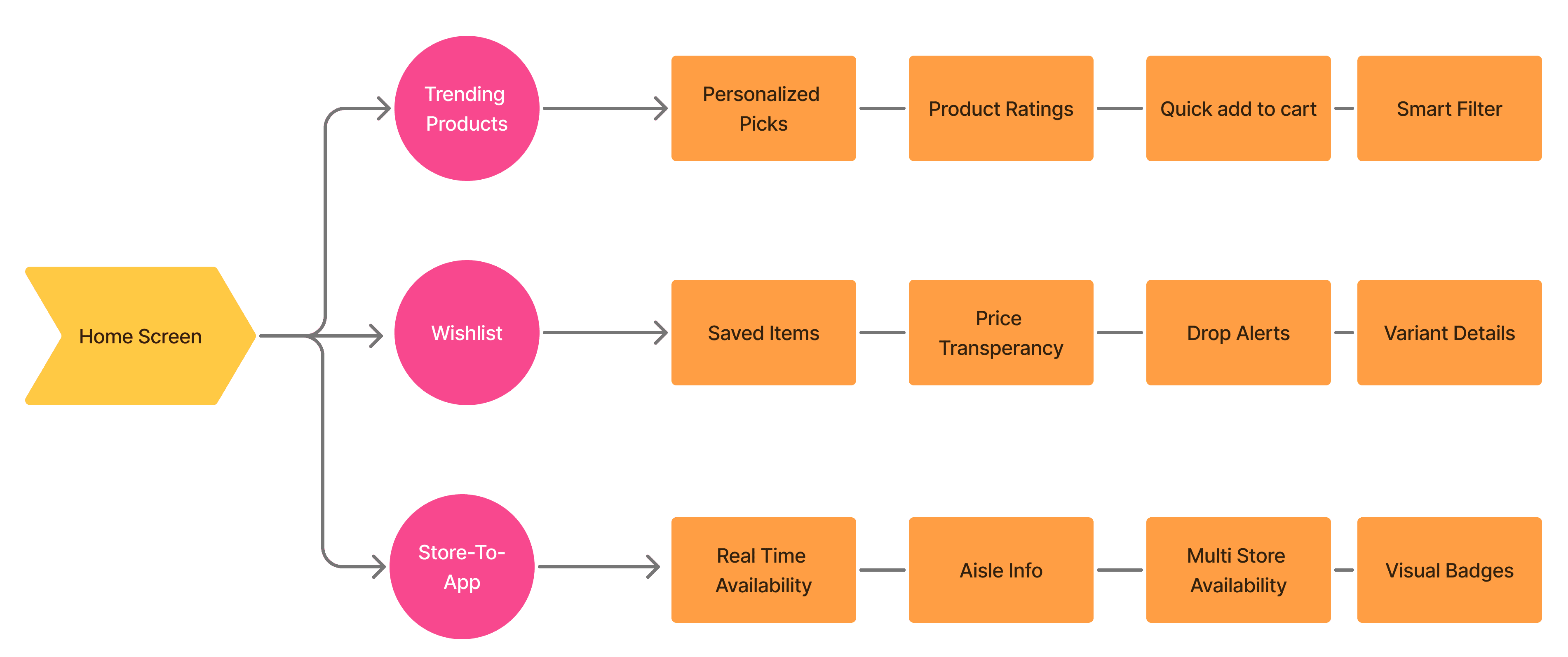
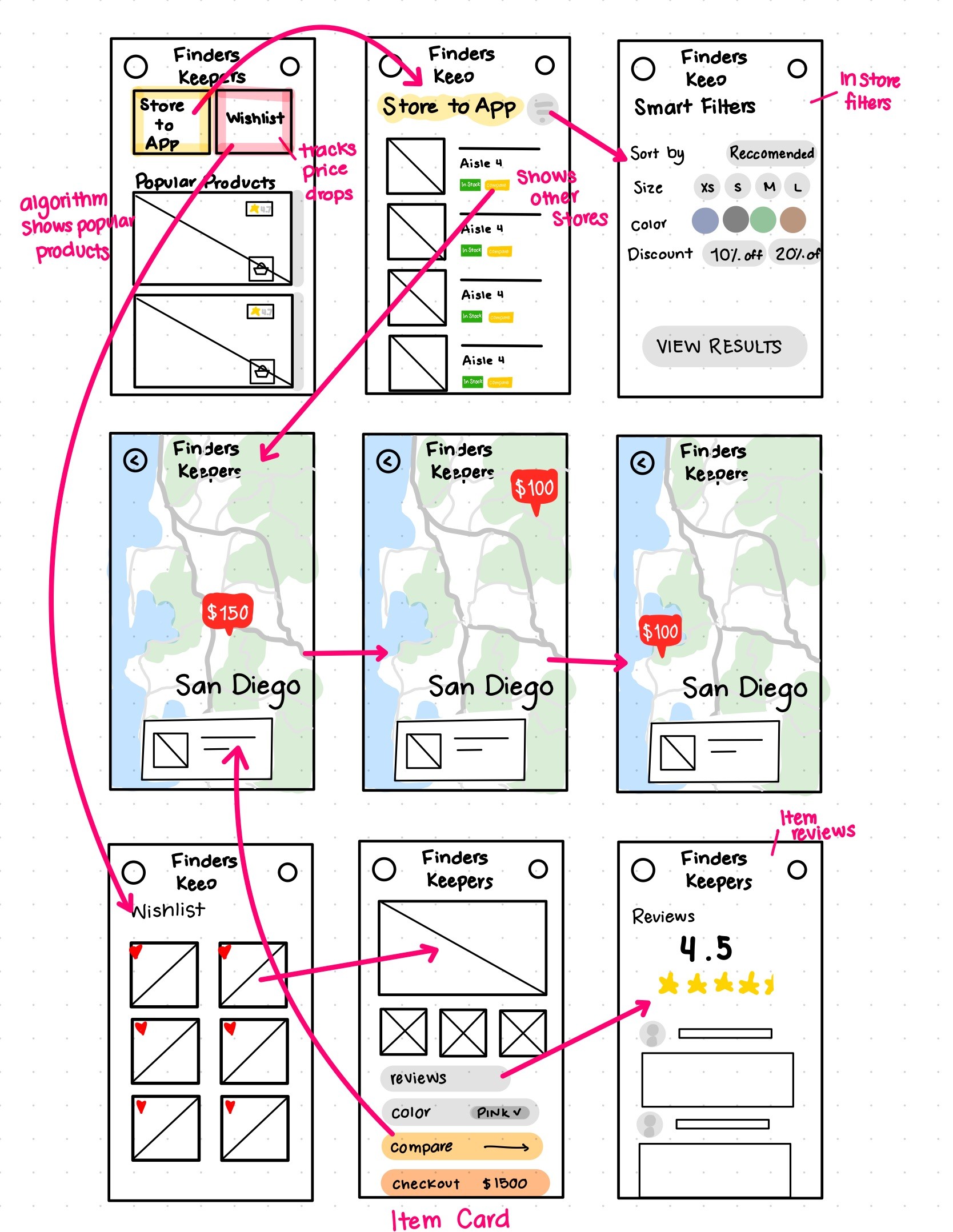
I started on paper, then moved to low-fi digital to pressure-test the flow. The whole app collapses into four "moments" a shopper actually has: I want to browse. I want to find something specific. I want to see what's nearby. I want to check out.
01
Hunt
02
Search + Filters
03
Flash Sale
04
Map Nearby
05
Product Details
06 • DESIGN SYSTEM
A Language for the hunt
PALETTE
Paper
FFF9EB
Sandy
F2E9D8
Black Ink
1A1615
Gray
E8E7EA
Tangerine
EA6534
Intense Cherry
CB1F28
Fern Green
479147
Click Amber
#FFEAA8
TYPE
Cropped Puffer Moncler
Syne • Display
TYPE
Go Hunt
Syne • UI
TYPE
Nordstrom Rack
Monserrat • Meta Data
08 • usability testing
the numbers told the story
I ran three rounds of usability testing starting with low-fi wireframes and ending with a hi-fi prototype. Each round surfaced real issues, which I fixed before the next round. Here's how the results changed.
What I was measuring: Could a first-time user open the app, find a flash sale item nearby, and add it to their Stash without any guidance from me? Each chart below tracks how that changed as I iterated on the design.
From hesitant to hunt-ready.
% of participants who completed the core task without dropping off or asking for help.
Found faster every time.
How long it took each participant to locate their first discounted item, from app open.
Feeling the win.
Post-task rating out of 5. "How satisfying was that experience?"
The biggest satisfaction jump came after adding the "you're saving $X" celebration banner in Stash. Users finally felt the win — not just saw the price.
Would they use it for real?
At the end of round 3, I asked every tester: "Would you download this app?"
"I rarely shop like that."
thanks for reading
Let's make something worth finding
Sarah Saavedra Camacho